

Blog
Mobile Pedestal Office Storage for Smarter Teams

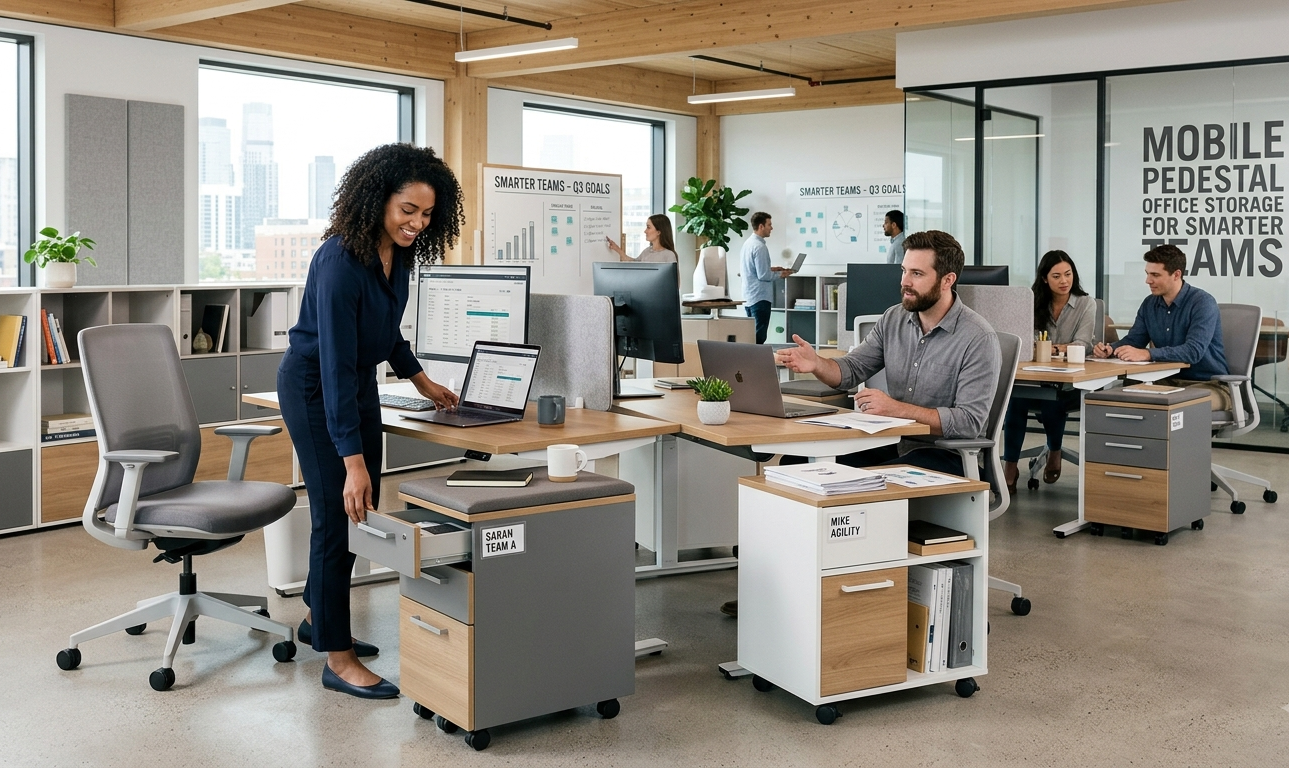
A desk can look well specified on a floor plan and still fail the people using it. The usual reason is not the desktop. It is the lack of a practical place for files, stationery, personal items, and the daily tools that accumulate around every role. Mobile pedestal office storage gives each employee a dedicated storage point without adding permanent visual weight to the workstation. For growing businesses and established offices alike, that small addition can create a sharper, more controlled workplace.
A mobile pedestal is not simply a drawer unit on casters. Positioned correctly, it supports focused work, protects confidential documents, and allows teams to adapt their layout as departments grow or project groups change. It also preserves the clean lines that make a modern workstation feel credible to employees, clients, and visitors.
Why Mobile Pedestals Improve Workplace Performance
Desk-level storage reduces the friction of routine work. When a team member has to leave their workstation to retrieve a signed document, locate a notebook, or find everyday supplies, the interruption is minor once but costly when repeated across a team. A pedestal puts those essentials within reach while keeping the desktop available for the work that requires attention.
Mobility is the defining advantage. Unlike fixed under-desk cabinets, a pedestal can move with an employee during a seating change, slide beside a collaborative bench for a short-term project, or be repositioned when the office is reconfigured. This matters for startups adding headcount, companies moving to a new floor, and facilities teams managing evolving workstation plans.
There is also a clear presentation benefit. Open shelving can work in archive areas, but it exposes visual clutter in an active work zone. A closed pedestal conceals paper stacks, cables, bags, and supplies behind coordinated drawer fronts. The result is a workstation that communicates order without demanding that employees keep every item in sight perfectly arranged.
Choosing Mobile Pedestal Office Storage That Fits
The best mobile pedestal office storage should fit the workstation, the user’s daily tasks, and the wider office finish. A compact unit that disappears beneath a desk may be ideal for hot-desking areas, while a larger three-drawer pedestal may be a stronger choice for administrators, finance teams, or managers who handle physical files throughout the day.
Start With Desk Clearance and Footprint
Measure the available space beneath the desk before selecting a pedestal. Check the clear height below the worktop, the leg position of the user, and the location of desk supports, cable trays, and modesty panels. A pedestal that technically fits but restricts knee clearance will quickly become an inconvenience.

For benching systems and clustered workstations, consider how the pedestal sits relative to neighboring seats. The unit should allow a chair to move freely and leave a comfortable entry path. In compact offices, a narrower pedestal is often the better decision, even if it offers one less drawer. Storage capacity matters, but employee comfort and circulation matter more.
Casters deserve the same attention as dimensions. Quality wheels allow the unit to move when needed and remain stable when parked. They should operate smoothly on the office flooring, whether that is carpet tile, vinyl, timber-effect flooring, or a hard commercial surface. A poorly rolling pedestal can damage floors and undermine the flexibility it is meant to provide.
Match Drawer Layout to the Work
Drawer configuration should follow the type of material employees use. A simple two-drawer unit works well for stationery, chargers, notebooks, and personal belongings. A three-drawer design provides stronger separation between supplies and documents. Where paper records remain central to operations, select a pedestal with a deeper filing drawer sized for the filing system your business uses.
A practical configuration often combines shallow utility drawers with one deeper file drawer. The shallow drawers keep small items from becoming a mixed pile, while the larger drawer accommodates folders, document wallets, or heavier equipment. This is particularly useful in legal, consulting, real estate, finance, and administrative environments where paper still has a daily role.
Do not overbuy storage for a paper-light team. In a digitally managed office, oversized filing capacity can take up valuable space with little return. A smaller locking pedestal, paired with shared department storage for occasional records, may create a more efficient workstation layout.
Treat Locking as a Business Requirement
Security is not reserved for executive offices. Employee records, client materials, contracts, financial information, and personal belongings all need appropriate protection. A central locking system that secures multiple drawers with one key is a practical option for individual use. It reduces the chance of leaving a single drawer unsecured at the end of the day.
For shared environments, establish clear ownership. A mobile pedestal is most effective when one person is responsible for its contents. In hot-desking settings, lockable storage can be assigned by shift, department, or role, but it should be supported by a simple key-management policy. Furniture can provide physical security; workplace procedures provide accountability.
Plan Storage by Office Zone
A successful office does not use the same storage solution everywhere. Mobile pedestals perform best at individual workstations, while vertical filing cabinets, credenzas, and larger storage cabinets serve shared or archive-heavy zones. Treat each piece as part of a coordinated storage strategy rather than expecting one cabinet type to solve every need.
At standard employee desks, a mobile pedestal supports daily organization and personal storage. In executive offices, it can sit beneath a return desk or alongside a work surface, maintaining easy access without interrupting the authority of a larger executive desk. Choose premium finishes that complement the desk, especially where clients or senior colleagues regularly enter the space.
Reception desks call for a different approach. Front-of-house teams often need concealed storage for forms, visitor materials, stationery, and personal effects, but they also need fast access during busy periods. A compact pedestal behind the reception counter can maintain a clean public-facing presentation while supporting efficient service.
For shared workstations, avoid placing one small pedestal between multiple users and assuming it will meet everyone’s needs. This often leads to unclear ownership and clutter spilling onto desk surfaces. Either provide a pedestal per user or combine individual compact units with a clearly defined shared storage cabinet nearby.
Details That Separate Commercial-Grade Storage
Commercial office furniture is expected to withstand frequent use, office moves, and everyday loading. Look beyond the number of drawers and assess the construction details that influence longevity. Durable drawer runners, stable cabinet bodies, dependable locking hardware, and properly fitted casters all protect the investment over time.
Finish selection also affects maintenance. Light tones can make a compact office feel more open, while dark executive finishes create depth and authority. Wood-grain surfaces bring warmth to professional service environments, and neutral solids integrate easily with contemporary workstation systems. The right choice depends on the surrounding desks, seating, flooring, and client-facing character of the space.
Drawer handles should feel comfortable and visually aligned with the furniture series. Recessed pulls offer a minimal, streamlined appearance and reduce projections into walkways. More pronounced handles may be easier to grip, especially in high-use settings. Neither choice is automatically better; the priority is a finish that supports daily operation and a consistent office aesthetic.
Consider load behavior as well. A pedestal filled with files is heavier than one used for personal supplies. Deeper drawers should open smoothly under realistic weight, and the unit should remain stable during normal use. Facilities teams should also encourage users to avoid overloading a single drawer, particularly when the pedestal is moved regularly.
Create a Coordinated, Professional Workstation
A workstation appears more intentional when its desk, chair, privacy panels, and storage share a considered visual language. Matching the pedestal finish to the desk is the straightforward choice, but a controlled contrast can work well in design-led offices. For example, a light workstation paired with a charcoal pedestal can ground the layout when the same accent appears in task chairs or divider panels.
The visual relationship should never compromise function. A pedestal that looks premium but blocks the user’s movement is not a premium solution. Likewise, a highly practical unit in an unrelated finish can weaken the polished presentation of an executive office or client meeting area. Desk Craft approaches storage as part of the complete office environment, where organization, comfort, and professional identity work together.
The most effective pedestal is the one employees use without thinking about it. Give every workstation enough secure, accessible storage for the work it supports, keep shared files in their proper zone, and let clear desktops reinforce the focus and confidence your business wants to project.


